Vertebroplasty and kyphoplasty
DraftNot yet reviewed by the clinical team · Last edited 14 October 2026
When a weak bone in your spine cracks and squashes down, it can cause severe back pain. The doctor fills the broken bone with medical bone cement through a hollow needle in your back, with no surgical cut and no stitches.
- Under an hour
- for one bone, longer for more
- A tiny nick
- in your back, no stitches
- Drowsy, not asleep
- with medicine to relax you, or fully asleep for some people
- Often home the same day
- after resting for 1 to 2 hours
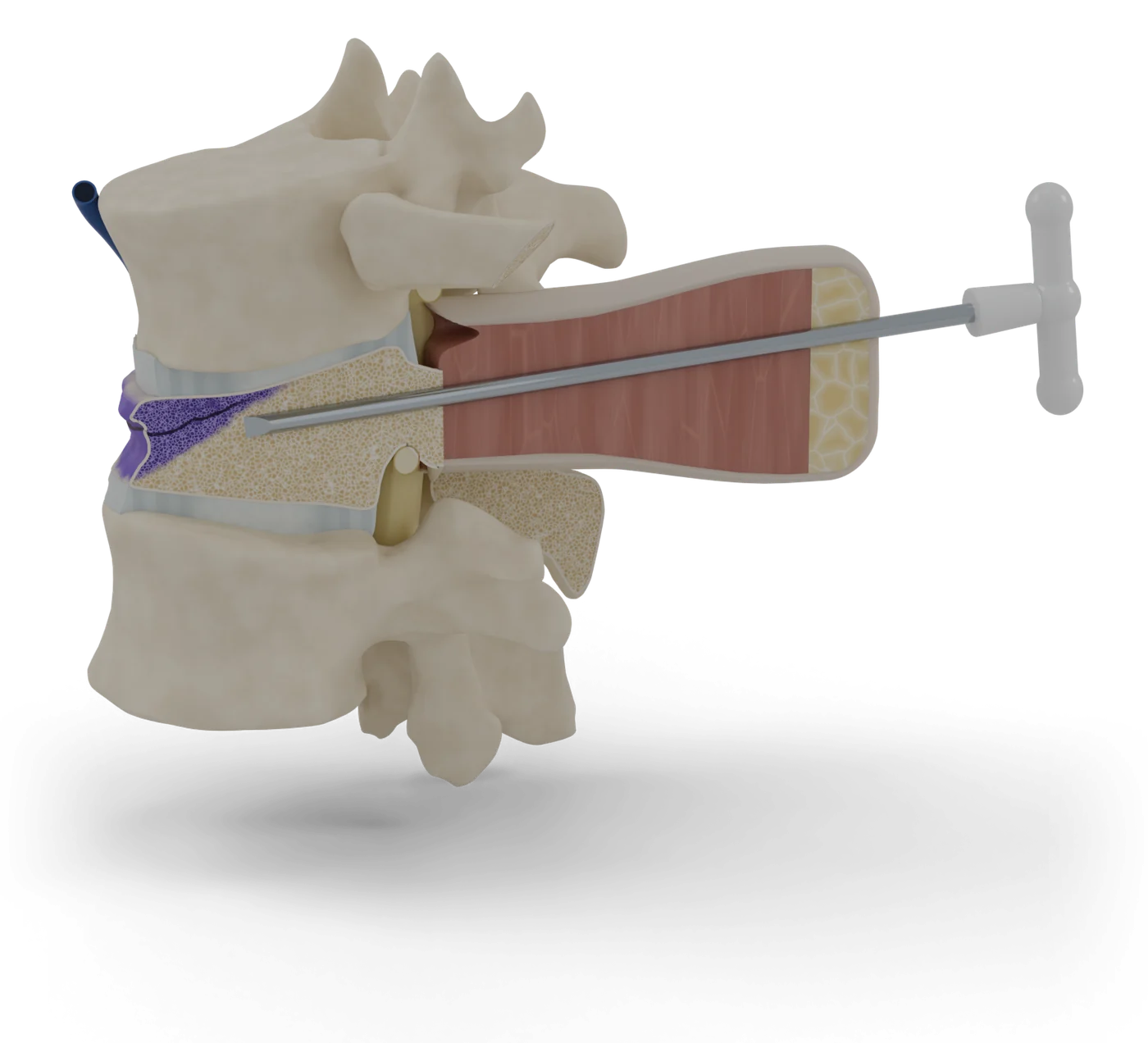
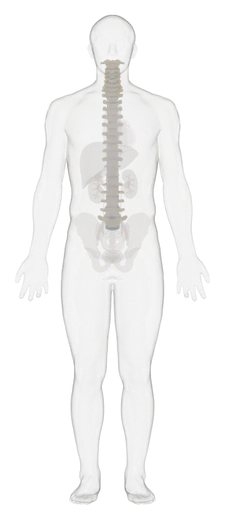
Where this happens: Spine. These treat a broken bone in the spine, most often in the middle of the back. The needle goes in through a tiny nick in the skin of your back.
The short version
Osteoporosis can make a bone in your spine so weak that it cracks and squashes down, which causes sudden back pain.
In vertebroplasty, the doctor puts a hollow needle through a tiny nick in your back and fills the broken bone with bone cement.
Kyphoplasty adds one step first: a small balloon makes a space inside the bone, and then the space is filled with cement.
The cement sets hard within about 20 minutes. Many people go home the same day and feel less pain within days, but it does not help everyone.
Step through it on the model
Start from the beginningEach step shows one thing on a 3D model you can turn. Jump to any step.
See all 12 steps
How it works
Is it for you
Your visit
What to do before, what happens on the day, and what recovery is usually like. Your care team will give you instructions for your own situation. Follow theirs if they differ.
Before your procedure
Things to do. Tick them off as you go; your ticks stay on this device only.
On the day
You change into a gown. Leave jewellery at home.
You sign a consent form once all your questions are answered.
A nurse puts a small tube (IV) in your hand or arm. Monitors check your heart rate, blood pressure and oxygen.
You may get antibiotics to prevent infection, and medicine for pain or nausea.
You lie face down on the X-ray table. Medicine through the IV makes you drowsy and relaxed. Some people have a general anesthetic instead.
Your skin is cleaned and numbed. You may feel pressure, and a tapping feeling as the needle goes into the bone. Tell the team if you feel pain.
For one bone it usually takes under an hour. More bones take longer.
Afterwards you lie down and rest for 1 to 2 hours, then you can usually get up and walk.
Recovery
- The first hours
Rest lying down for 1 to 2 hours while the team checks on you. After about an hour, most people can get up and walk. Many go home that day with an adult driver. Some stay overnight.
- Days 1 to 3
Soreness where the needle went in is normal and usually lasts 2 to 3 days. An ice pack wrapped in a cloth, for 15 minutes each hour, can help. Leave the bandage on for 48 hours and do not soak it in water. Showers are fine.
- Pain relief
Many people find their fracture pain eases right away or within about 2 days. Your usual pain medicine should be enough.
- The first weeks
Slowly do a little more each day. Avoid heavy lifting and hard exercise for at least 6 weeks. Do not drive on the day of the procedure, and ask when you can drive again.
- Follow-up
You may have a check-up visit, scans or blood tests. If you have osteoporosis, ask about treatment to protect your other bones.
When to get help
Call 9-1-1 now if you have
- Sudden trouble breathing
- Chest pain
- New weakness in your legs
- You cannot control your bladder or bowels
- Bleeding from the needle site that does not stop with firm pressure
Call the interventional radiology (IR) team today if you have
- A fever
- Swelling or a change in skin colour where the needle went in
- Back pain that is getting worse instead of better
- New numbness or tingling
Phone number added by the hospital before launch
If you can’t reach them, go to the nearest emergency department.
Not sure? Call HealthLink BC at 8-1-1
- Health questions that are not urgent, such as soreness, your bandage or your medicines, if you cannot reach the IR team
A nurse can give health advice any time, day or night.
Call 8-1-1Deaf or hard of hearing: call 7-1-1. Translation services are available in over 130 languages.
Benefits and risks
What it can do for you
- No surgical cut: just a small nick in the skin that does not need stitches.
- Usually under an hour for one bone, and often home the same day.
- Many people feel less pain right away or within a few days.
- Patient guides report that from about half to 9 in 10 people have less pain or move better afterwards. The numbers vary from study to study.
- Getting up and moving sooner can lower the risk of pneumonia (a lung infection) and help keep your muscles strong.
- Kyphoplasty may give back some of the bone’s lost height.
What can go wrong
Every procedure has some risk, and most people do not have a serious problem. Each risk is listed with how often it happens. They are grouped on one scale, from very common to very rare.
Very common: more than 1 in 10 people
A small cement leak
Scans find a small leak in about 1 in 4 to 3 in 4 treated bones. Almost all cause no symptoms.
A little cement seeps just outside the bone, often into the disc above or below. It almost never causes problems. Leaks are found less often after kyphoplasty (about 29 in 100) than after vertebroplasty (about 39 in 100).
Common: 1 in 10 to 1 in 100 people
Cement travelling to the lungs
About 2 in 100 people have cement in the lungs on scans, usually with no symptoms. Breathing problems happen to about 1 in 500 people, says one patient leaflet.
A little cement gets into a vein and travels to the lungs. Usually it causes no symptoms. In a few people, it causes breathing problems.
A new break in a nearby bone
About 1 in 10 people.
Another spine bone, often the one just above or below, breaks later. Pain can come back after a few days of relief. People with osteoporosis are at risk anyway: about 1 in 5 have another spine fracture within a year of the first. Studies disagree on whether the cement adds to this.
Uncommon: 1 in 100 to 1 in 1,000 people
Bleeding or a bruise where the needle went in
1 in 149 people had a serious bleed.
Where this number comes from
1 in 149 people had a serious bleed, in one large study.
A small bruise or a little bleeding can happen where the needle went in. A serious bleed is less common.
Cement pressing on a nerve or the spinal cord
About 1 in 500 people, says one patient leaflet. Paralysis is rarer still.
Cement, or rarely bleeding, reaches the tunnel behind the bone and presses on a nerve or the spinal cord. This can cause pain, numbness or weakness, and may need an urgent operation.
Rare: 1 in 1,000 to 1 in 10,000 people
Infection
Fewer than 1 in 1,000 people need antibiotics for an infection.
Germs get into the treated bone. Antibiotics are often given beforehand to prevent this.
Other options
Other options (6)
Questions to ask
Tick the ones you want to ask. Your ticks stay on this device only.
Check your understanding
Check your understanding (4)
Nothing is saved. It is just for you.
Both fill the broken bone with cement through a needle. Kyphoplasty adds a balloon step first.
Medical bone cement goes in as a thick paste and sets hard within about 20 minutes, like a cast on the inside.
It treats the one broken bone. Bone-strengthening medicine is what lowers the chance of new fractures.
Sudden trouble breathing, chest pain, or new weakness in your legs needs emergency help right away.
Words used
Words used (12)
- Vertebra
- One of the bones that stack up to make your spine. More than one are called vertebrae.
- Vertebral body
- The thick, round front part of a vertebra that carries your weight.
- Compression fracture
- A break where a vertebra squashes down and loses height.
- Osteoporosis
- A condition where bones become thin and weak, so they break more easily.
- Vertebroplasty
- Filling a broken vertebra with bone cement through a needle.
- Kyphoplasty
- Like vertebroplasty, but a small balloon first makes space in the bone.
- Bone cement
- A medical paste, like toothpaste, that sets hard inside the bone. Its full name is PMMA.
- Trocar
- A hollow needle the doctor guides into the bone.
- Pedicle
- A short, strong bridge of bone at the back of a vertebra. The needle usually passes through it.
- Fluoroscopy
- Live X-ray video that lets the doctor watch the needle and the cement.
- Sedation
- Medicine that makes you drowsy and relaxed, but not fully asleep.
- Interventional radiologist
- A doctor who treats problems through tiny openings, guided by imaging.
Sources
Sources (25)
- RadiologyInfo.org (RSNA and ACR). Vertebroplasty and kyphoplasty (reviewed June 2026)
- Cardiovascular and Interventional Radiological Society of Europe (CIRSE). Vertebral augmentation, patient information
- Society of Interventional Radiology. Back pain, patient information
- Cleveland Clinic. Kyphoplasty
- Cleveland Clinic. Compression fractures
- NHS (UK), hospital trust patient leaflet. Vertebroplasty (repair of vertebrae with bone cement), May 2026
- NHS (UK), health board patient booklet. A guide to your vertebroplasty (2024)
- National Institute for Health and Care Excellence (NICE). TA279: Percutaneous vertebroplasty and percutaneous balloon kyphoplasty for treating osteoporotic vertebral compression fractures
- Osteoporosis Canada. Facts and stats
- Cochrane Database of Systematic Reviews. Percutaneous vertebroplasty for osteoporotic vertebral compression fracture (2018)
- BMJ. Vertebroplasty versus sham procedure for painful acute osteoporotic vertebral compression fractures (VERTOS IV), 2018
- The Lancet. Safety and efficacy of vertebroplasty for acute painful osteoporotic fractures (VAPOUR), 2016
- The Lancet. Efficacy and safety of balloon kyphoplasty compared with non-surgical care for vertebral compression fracture (FREE), 2009
- Journal of Bone and Mineral Research (ASBMR). The efficacy and safety of vertebral augmentation: a second ASBMR task force report (2019)
- Revista da Associação Médica Brasileira. Kyphoplasty versus vertebroplasty for osteoporotic vertebral compression fractures: a systematic review and meta-analysis of randomized trials (2026)
- European Spine Journal. Clinical significance of cement leakage in kyphoplasty and vertebroplasty: a systematic review (2024)
- International Journal of Surgery. Risk factors for pulmonary cement embolism associated with percutaneous vertebral augmentation: a systematic review and meta-analysis (2022)
- Medicine (Baltimore). Complications of percutaneous vertebroplasty: an analysis of 1100 procedures performed in 616 patients (2016)
- Surgery Research and Practice. Percutaneous vertebral body augmentation: an updated review (2014)
- Frontiers in Surgery. Incidence of new osteoporotic adjacent vertebral body fractures: conservative treatment compared with vertebral body augmentation, a systematic review and meta-analysis (2025)
- Medicina (Kaunas). Complications of percutaneous vertebroplasty: a pictorial review (2023)
- American Academy of Orthopaedic Surgeons (OrthoInfo). Osteoporosis and spinal fractures
- Osteoporosis Canada. Osteoporosis and pain: helping your body help itself (April 2021)
- Canadian Anesthesiologists Society. Guidelines to the practice of anesthesia, revised edition 2026, section 4.2 (fasting)
- HealthLink BC. HealthLink BC 8-1-1 services
About this guide
About this guide
- Status
- Draft: not yet reviewed by the clinical team. The interventional radiology team will review it before it is used with patients, and the date of that review will show here.
- How it was written
- Drafted with AI writing tools from 24 published sources, then fact-checked against those sources by a separate AI check. Anything the sources did not support was taken out. The interventional radiology team will review it before it is used with patients.
- Last edited
- 14 October 2026
- Document
- Pathway P-003 · Version 0.5 · Last reviewed: not yet · Next review: 12 months after sign-off · Owner: the interventional radiology team
Was this guide clear?
Tell us if anything was hard to follow, or if something on the page looks wrong. Please do not include details about your own health. For questions about your care, contact your care team.
Both open an email to the project team. Project email: added before launch