Varicose vein treatment
Also called vein ablation
DraftNot yet reviewed by the clinical team · Last edited 14 October 2026
Varicose veins happen when tiny valves in a leg vein leak and the vein stretches. In this treatment, the team numbs your leg and uses a thin tube to heat the leaky vein from the inside, so it seals shut. You stay awake and most people go home the same day.
- Awake
- with numbing medicine in your leg
- About an hour
- for the whole procedure
- Home same day
- for most people
- Walk right away
- and wear a stocking for about a week
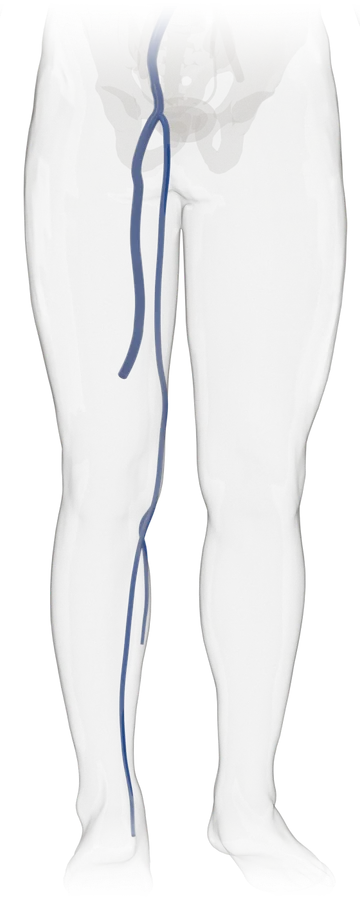
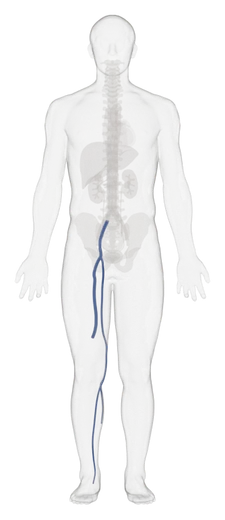
Where this happens: Leg. The treatment seals the long vein on the inner side of the leg, from below the knee up to the groin. The tube goes in through a tiny opening below the knee or near the ankle.
The short version
Varicose veins happen when tiny one-way valves in a leg vein leak, so blood falls back down and the vein stretches and bulges.
In this treatment, the team numbs your leg and uses ultrasound to slide a thin tube into the leaky vein, then heats it from the inside so it seals shut.
Your blood simply takes other, healthy veins back to your heart, and most people walk out and go home the same day.
Wear your stocking, walk every day, and call if your leg gets very swollen or painful, because a small number of people get a blood clot.
Step through it on the model
Start from the beginningEach step explains one thing. The 3D model for this guide is being made. Jump to any step.
See all 12 steps
What it treats
Your visit
What to do before, what happens on the day, and what recovery is usually like. Your care team will give you instructions for your own situation. Follow theirs if they differ.
Before your procedure
Things to do. Tick them off as you go; your ticks stay on this device only.
On the day
Arriving. You change into a gown. The team explains the procedure again and asks you to sign a consent form. You can still ask questions.
Numbing. You stay awake. Your leg is numbed with local anesthetic. Some people also get a mild medicine to help them relax.
The room. A clinic or hospital procedure room with an ultrasound machine. If a laser is used, you wear protective glasses.
Who. An interventional radiologist, or a vascular surgeon or vein specialist, and their team.
How long. The procedure usually takes about an hour. With laser, the heating itself takes only about 3 to 5 minutes.
Going home. You get up and walk, and most people go home the same day. Someone else should drive you.
Recovery
- Right away
Walk soon after the procedure. Wear your compression stocking.
- The first few days
Take short walks several times a day. Raise your leg above your heart when you sit or lie down. Ask your team which pain medicine is safe. Keep the small opening clean and dry, and stay out of pools and hot tubs while it heals.
- The stocking
Wear it as your team tells you. Advice varies. Some teams say to wear it day and night for 2 to 3 days, then only while awake. Often it is about a week in total.
- The first week
Most people get back to everyday things within a day or two, and to work within a few days. Avoid hard exercise and sitting still for a long time, such as on a long car ride. Ask when you can drive.
- About 1 week
An ultrasound checks that the vein is closed and looks for problems, such as a clot.
- The first weeks
Bruising, tightness and tingling along the inner leg get better over a few weeks. Ask before you fly. Some teams say to wait 2 weeks.
- Months later
The sealed vein shrinks. Some small branch veins may need another treatment. New varicose veins can form over the years.
When to get help
Call 9-1-1 now if you have
- Sudden chest pain with shortness of breath
- Severe trouble breathing
- Coughing up blood
- Fainting (passing out)
Call the interventional radiology (IR) team today if you have
- Pain, swelling or tenderness in your calf, behind your knee, or in your thigh or groin (this can be a blood clot)
- Your leg, calf, foot or groin swells
- The skin of your leg turns red, purple or dark
- Pain that does not get better after you take pain medicine
- Bleeding from the small opening where the tube went in
- A leg, foot or toes that are cold, pale, blue, numb or tingly
- More redness, warmth or swelling around the treated area
- Red streaks or pus coming from the treated area
- A fever
- A tender lump in your leg
Phone number added by the hospital before launch
If you can’t reach them, go to the nearest emergency department.
Not sure? Call HealthLink BC at 8-1-1
- You are not sure if something is normal
- Questions about your stocking, walking or medicines when your team is closed
- Non-urgent health advice from a nurse or other health professional
A nurse can give health advice any time, day or night.
Call 8-1-1Deaf or hard of hearing: call 7-1-1. Translation services are available in over 130 languages.
Benefits and risks
What it can do for you
- It works for most people: the vein closes in about 98 in 100 people at 1 month, and stays closed in about 93 to 94 in 100 at 1 year.
- Laser and radiofrequency work about as well as each other.
- Fewer problems than surgery: in one large trial, about 1 in 100 people had a problem from laser treatment, compared with 7 in 100 after surgery.
- Better long-term relief than foam injections: 5 years later, people treated with laser rated their leg symptoms better than people treated with foam.
- You stay awake, there is only a tiny opening, most people need no stitches, and most go home the same day.
- A faster recovery than surgery: people got back to everyday activities sooner.
- To be fair: smaller branch veins often need extra treatment, new varicose veins can form over the years, and some people need more than one session.
What can go wrong
Every procedure has some risk, and most people do not have a serious problem. Each risk is listed with how often it happens. They are grouped on one scale, from very common to very rare.
Very common: more than 1 in 10 people
Bruising, soreness or a skin burn
About 11 to 15 in 100 people had bruising or a skin burn in the first month (most of this is bruising)
Where this number comes from
About 11 to 15 in 100 people had bruising or a skin burn in the first month (most of this is bruising), from a 2024 review of studies.
Bruising and tenderness along the treated vein are common and fade over a few weeks. A heat burn of the skin can also happen.
Common: 1 in 10 to 1 in 100 people
A blood clot in a deep vein
About 2 in 100 people had a clot reaching a deep vein, from a 2018 review of 52 studies. A true deep vein clot (DVT) happened to about 3 in 1,000. A clot in the lungs happened to about 1 in 1,000 or fewer.
The clot that seals the vein can sometimes reach into the deep vein at the groin, or a clot can form in another deep vein. The check-up scan looks for these clots. Many go away on their own or with a short course of blood-thinning medicine. Less often, a piece of clot travels to the lungs, which is serious.
Tingling or numbness
About 3 in 100 people in the first month.
Where this number comes from
About 3 in 100 people in the first month, from a 2024 review of 17 studies.
The heat can irritate a small skin nerve that runs beside the vein. You may feel tingling, burning or a numb patch. It usually gets better over time.
A sore, lumpy vein (phlebitis)
About 4 in 100 people in the first month.
Where this number comes from
About 4 in 100 people in the first month, from a 2024 review of 7 studies.
The treated vein or its branches can feel hard, red and sore for a while. Ice and anti-inflammatory pain medicine usually help.
Brown skin staining
About 4 to 7 in 100 people in the first month.
Where this number comes from
About 4 to 7 in 100 people in the first month, from a 2024 review of 8 studies.
The skin over the treated vein can turn a brown colour.
The vein does not stay closed
About 2 in 100 at 1 month, from a 2024 review of studies. About 6 to 7 in 100 by 1 year.
Sometimes the vein does not close fully, or opens up again. It can be treated again with another ablation or a different treatment.
Rare: 1 in 1,000 to 1 in 10,000 people
Infection
Fewer than 1 in 1,000 people need antibiotics for an infection.
The small opening can get infected and need antibiotics.
Other options
Other options (6)
Questions to ask
Tick the ones you want to ask. Your ticks stay on this device only.
Check your understanding
Check your understanding (5)
Nothing is saved. It is just for you.
When the one-way valves leak, blood falls back down the vein. The vein stretches, swells and twists.
The vein stays in place but closes. Your blood takes your other healthy veins back to your heart.
The team uses numbing medicine. Some people also get a mild medicine to help them relax.
Walking and the stocking help prevent swelling and clots. Avoid hard exercise until your team says it is okay.
This can be a sign of a blood clot. Call the IR team now. Call 9-1-1 for chest pain or trouble breathing.
Words used
Words used (12)
- Varicose veins
- Swollen, twisted veins just under the skin, usually in the legs.
- Valve
- A tiny one-way flap inside a vein that stops blood from falling back down.
- Reflux
- Blood flowing the wrong way, back down a vein, because the valves leak.
- Great saphenous vein
- The long vein just under the skin on the inner side of the leg, from the ankle to the groin.
- Deep veins
- Large veins deep inside the leg muscles. They carry blood back to the heart.
- Duplex ultrasound
- A scan that uses sound waves to show the veins and the way the blood flows.
- Endovenous ablation
- Sealing a vein from the inside with heat. Endovenous means inside a vein.
- Catheter
- A thin, soft tube put into a vein.
- Tumescent anesthesia
- Numbing fluid injected all around the vein to cushion it and protect nearby tissue from the heat.
- Compression stocking
- A tight, stretchy stocking that squeezes the leg to help blood flow and ease swelling.
- Sclerotherapy
- Injecting a medicine, as a liquid or foam, into a vein so it scars shut.
- Deep vein thrombosis (DVT)
- A blood clot in a deep vein.
Sources
Sources (26)
- HealthLink BC. Varicose Veins (current as of December 19, 2022)
- HealthLink BC. Radiofrequency Ablation for Varicose Veins
- HealthLink BC. Laser Treatment for Varicose Veins
- HealthLink BC. Sclerotherapy
- RadiologyInfo.org (ACR and RSNA). Varicose Vein Treatment (Endovenous Ablation) (reviewed August 2024)
- NHS. Varicose veins (reviewed July 2024)
- NHS. Varicose veins: treatment
- Cleveland Clinic. Endovenous Thermal Ablation (updated October 2022)
- National Heart, Lung, and Blood Institute (US NIH). Varicose veins (updated September 2023)
- Healthwise, via MyHealth.Alberta.ca (Government of Alberta). Endovenous Ablation for Varicose Veins: What to Expect at Home (current as of July 2024)
- Society for Vascular Surgery. Varicose veins, patient page
- National Institute for Health and Care Excellence (NICE). Varicose veins: diagnosis and management (CG168), Recommendations
- Journal of Epidemiology and Community Health (Edinburgh Vein Study). Prevalence of varicose veins and chronic venous insufficiency in men and women in the general population (1999)
- Journal of Vascular Surgery: Venous and Lymphatic Disorders. Endovenous radiofrequency ablation vs laser ablation in patients with lower extremity varicose veins: a meta-analysis (2024)
- European Journal of Vascular and Endovascular Surgery. A systematic review and meta-analysis of thrombotic events following endovenous thermal ablation of the great saphenous vein (2018)
- Phlebolymphology. Pathogenesis, diagnosis, and treatment of endothermal heat-induced thrombosis (EHIT) (2024)
- Cochrane Database of Systematic Reviews. Interventions for great saphenous vein incompetence (2021)
- New England Journal of Medicine (CLASS trial). A randomized trial comparing treatments for varicose veins (2014)
- New England Journal of Medicine (CLASS trial). Five-year outcomes of a randomized trial of treatments for varicose veins (2019)
- British Journal of Surgery (CLASS trial). Behavioural recovery after treatment for varicose veins (2016)
- European Journal of Vascular and Endovascular Surgery. Thermal versus non-thermal endovenous ablation in superficial venous incompetence: systematic review and meta-analysis of randomised controlled trials (2023)
- Journal of Vascular Surgery: Venous and Lymphatic Disorders (SVS, AVF and AVLS). 2022 clinical practice guidelines for the management of varicose veins of the lower extremities, Part I (abstract)
- Society of Interventional Radiology (SIR). Superficial venous disease or chronic venous insufficiency, patient page (reviewed September 2024)
- NHS. Deep vein thrombosis (DVT)
- Healthwise, via Kaiser Permanente health encyclopedia. Endovenous Ablation for Varicose Veins: What to Expect at Home (2026 revision; kept only for the cold or pale leg warning sign)
- HealthLink BC. HealthLink BC 8-1-1 services
About this guide
About this guide
- Status
- Draft: not yet reviewed by the clinical team. The interventional radiology team will review it before it is used with patients, and the date of that review will show here.
- How it was written
- Drafted with AI writing tools from 25 published sources, then fact-checked against those sources by a separate AI check. Anything the sources did not support was taken out. The interventional radiology team will review it before it is used with patients.
- Last edited
- 14 October 2026
- Document
- Pathway P-009 · Version 0.5 · Last reviewed: not yet · Next review: 12 months after sign-off · Owner: the interventional radiology team
Was this guide clear?
Tell us if anything was hard to follow, or if something on the page looks wrong. Please do not include details about your own health. For questions about your care, contact your care team.
Both open an email to the project team. Project email: added before launch