PICC line
Peripherally inserted central catheter
DraftNot yet reviewed by the clinical team · Last edited 14 October 2026
A PICC is a long, thin tube that goes into a vein in your upper arm and ends in a large vein just above your heart. It is put in while you are awake, with numbing medicine, and it lets your care team give treatment for weeks or months without a new needle each time.
- Awake
- with numbing medicine in your arm
- 30 to 60 minutes
- to put the line in
- Home same day
- for most people
- Weeks to months
- it stays in while you need it
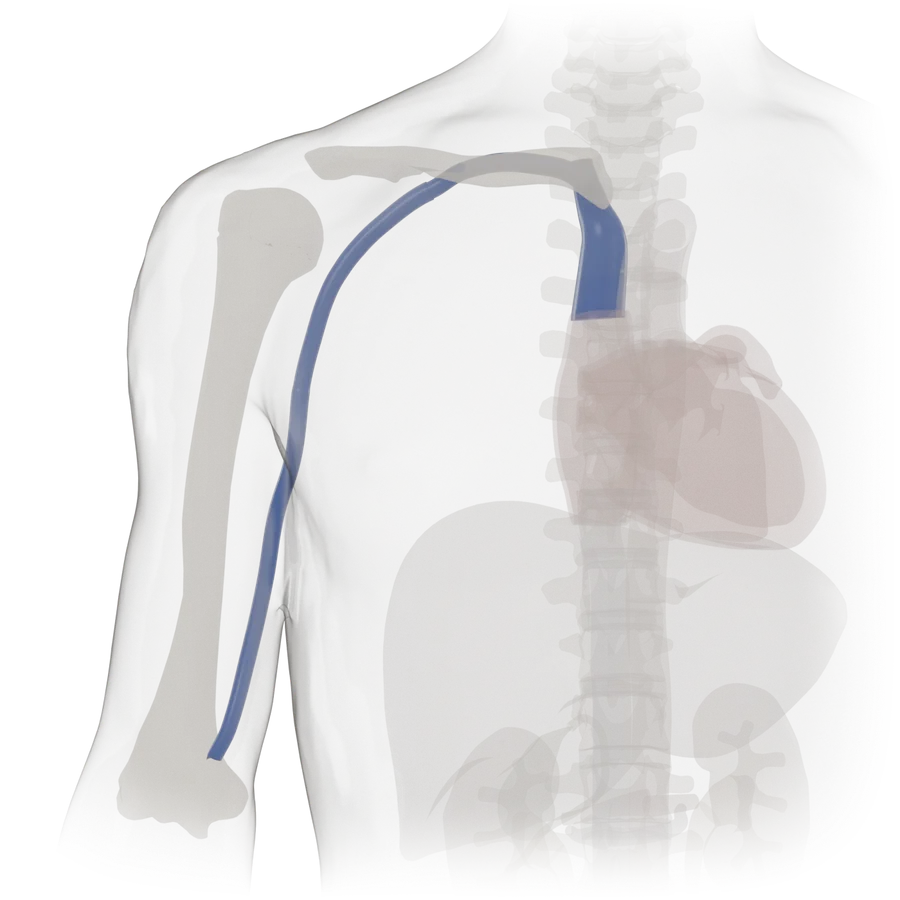
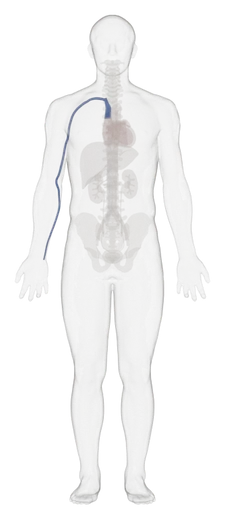
Where this happens: Arm. The line goes in on the inside of the upper arm, above the elbow. Its tip rests in a large vein just above the heart.
The short version
A PICC is a long, thin, soft tube that goes into a vein in your upper arm and ends in a large vein just above your heart.
It lets your care team give you medicine, fluids, liquid food or blood for weeks or months without a new needle each time.
You stay awake while the team numbs your arm and guides the tube into place, and most people go home the same day.
Keep the dressing clean and dry, and call right away for a fever or a swollen arm. When you are done, a nurse usually slides the line out.
Step through it on the model
Start from the beginningEach step explains one thing. The 3D model for this guide is being made. Jump to any step.
See all 12 steps
Your visit
What to do before, what happens on the day, and what recovery is usually like. Your care team will give you instructions for your own situation. Follow theirs if they differ.
Before your procedure
Things to do. Tick them off as you go; your ticks stay on this device only.
On the day
You change into a gown and take off jewellery from that arm.
You lie on your back with your arm out on a support. Monitors check your heart rate and blood pressure.
Ultrasound finds the vein. Your skin is cleaned and numbed. The sting of the numbing medicine is usually the only painful part.
The line is guided up to your chest with live X-ray, then checked, flushed and covered with a clear dressing.
Putting the line in usually takes 30 to 60 minutes. Most people go home the same day.
Recovery
- The same day
Rest for the rest of the day. Some soreness, bruising or swelling where the line went in is common.
- The next day
You can usually go back to your normal activities. Avoid heavy lifting with that arm.
- Your first shower
Ask your team when. Advice ranges from 1 day to 1 week. Always cover the dressing and caps.
- The first weeks
Bruising usually fades in a few days. Soreness often lasts 1 to 3 days, but can last up to 2 or 3 weeks.
- Every week
A nurse changes the dressing and caps, and flushes the line if it is not used every day.
- When treatment ends
A nurse slides the line out in a few minutes. A small dressing goes over the spot.
When to get help
Call 9-1-1 now if you have
- Sudden chest pain and shortness of breath.
- Coughing up blood.
- Severe trouble breathing.
- Fainting.
- A fast or uneven pulse.
- Chest pain or trouble breathing after a cap came off or the line cracked. Clamp the line and lie on your left side.
Call the interventional radiology (IR) team today if you have
- A fever of 38 °C or higher, or chills.
- Redness, warmth, swelling, red streaks or more pain where the line goes in.
- Pus or blood draining from where the line goes in.
- Swelling of your arm, shoulder, chest, neck or face on the side of the line.
- Bulging veins near the line.
- The line leaks, cracks or is cut. Clamp or tie it between the damage and your skin.
- The line is hard to flush, or it hurts when fluid goes in.
- The line has slipped out partly or fully, or the outside part has changed length. If it came out, press on the spot until the bleeding stops.
- Tingling or pinching in the arm, hand or fingers on that side.
- The dressing is wet, loose or dirty.
Phone number added by the hospital before launch
If you can’t reach them, go to the nearest emergency department.
Not sure? Call HealthLink BC at 8-1-1
- Questions that are not urgent.
- You cannot reach your care team and are not sure how urgent something is.
A nurse can give health advice any time, day or night.
Call 8-1-1Deaf or hard of hearing: call 7-1-1. Translation services are available in over 130 languages.
Benefits and risks
What it can do for you
- Medicine, fluids, liquid food or blood can go in without a new needle each time. Blood for tests can often be taken from it too.
- Medicines that would harm small veins go into a large vein instead.
- Many people can have their treatment at home.
- It is ready to use as soon as it is in.
- It can stay in for weeks or months. In one large Canadian program, half the lines stayed in for 45 days or longer.
- Placement almost always works. In a study of over 2,000 lines placed with ultrasound by IR teams, 996 in 1,000 were placed successfully.
What can go wrong
Every procedure has some risk, and most people do not have a serious problem. Each risk is listed with how often it happens. They are grouped on one scale, from very common to very rare.
Very common: more than 1 in 10 people
Blocked line
About 7 to 11 in 100 lines.
Where this number comes from
About 7 to 11 in 100 lines, across three studies.
Blood or medicine can block the inside of the line. It can usually be cleared by flushing or with clot-dissolving medicine. Sometimes the line is replaced. It is one of the most common problems, and more likely when the line has more than one tube.
Sore skin or a sore vein
About 12 in 100 people had sore skin from the dressing, in one study of people having chemotherapy. About 5 in 100 had a sore vein.
The sticky dressing can irritate or damage the skin under it. The vein near where the line goes in can also become sore, red and swollen. This is called phlebitis. It is more likely if the line stays in for 2 months or more.
Common: 1 in 10 to 1 in 100 people
Line slips or is pulled out
About 7 to 9 in 100.
Where this number comes from
About 7 to 9 in 100, in two studies.
The line can slide out partly or fully if it catches on something or the dressing comes loose. It may need to be replaced.
Skin infection
About 5 in 100.
Where this number comes from
About 5 in 100, in two studies.
Redness, warmth or pus where the line goes in. It is treated with antibiotics. Sometimes the line comes out.
Infection in the blood
About 1 in 100 lines.
Where this number comes from
About 1 in 100 lines (0.6 to 1.6 in 100, across three studies).
An infection can spread into the blood. This is serious. It needs antibiotics, and the line may need to come out.
Blood clot in the arm veins
About 1 to 4 in 100 people overall.
A clot can form in the veins around the line. Your arm, shoulder, neck or face may swell or ache. It is treated with blood thinners, and sometimes the line comes out. Sudden chest pain or trouble breathing is an emergency. Clots are more likely in people who are very ill in hospital (about 1 in 10 or more) or who have cancer (about 7 to 16 in 100, in different studies). Clots are about 2.5 times as likely with a PICC as with other central lines. If you have kidney disease, damage to these veins can make dialysis in that arm harder later.
Bruising, bleeding, or a nick to an artery or nerve
About 1 to 3 in 100.
Where this number comes from
About 1 to 3 in 100, across three studies.
A bruise or a little bleeding where the line goes in. Rarely, the needle nicks an artery or touches a nerve near the vein. This can cause bleeding, or tingling or pain in the arm or hand. Ultrasound helps the team avoid them.
Line cracks, leaks or lets air in
Cracks were found in about 4 in 100 lines, in one study of people having chemotherapy. How often air gets in is not known.
The line can split or leak. Pain when it is flushed can be a sign. If a cap comes off or the line cracks, air can get into the vein. This can cause sudden chest pain or trouble breathing. Keep the caps on and any clamps closed. Patient guides say cracks are uncommon or very rare.
Uncommon: 1 in 100 to 1 in 1,000 people
Tip in the wrong place, or heartbeat changes
In one study, none of 100 lines placed with live X-ray were in the wrong place. Skipped beats later on are rare.
The tip can end up in the wrong vein, or move when you move your arm. If the tip touches the heart, it can cause extra or uneven heartbeats. This usually happens while the line is being placed, and stops when the tip is moved back a little. Tell your team if you feel skipped beats later. Live X-ray during placement helps get the tip in the right place. In one study, 60 of 100 lines placed without live X-ray were in the wrong place.
Other options
Other options (6)
Questions to ask
Tick the ones you want to ask. Your ticks stay on this device only.
Check your understanding
Check your understanding (5)
Nothing is saved. It is just for you.
The line goes in at the upper arm and follows your veins. The tip rests where the large vein meets your heart.
Once your skin is numb, most people feel only pushing or pressure.
Keep the line dry. Do not soak it in a bath, pool or hot tub.
Swelling of the arm, hand, neck or face can be a sign of a clot. Call right away. If you also have chest pain or trouble breathing, call 9-1-1.
Taking it out is quick and usually does not hurt. A dressing goes over the spot.
Words used
Words used (12)
- PICC
- Peripherally inserted central catheter. A long, thin tube put in through an arm vein, with its tip in a large vein near the heart.
- Catheter
- A thin, flexible tube.
- Vein
- A blood vessel that carries blood back to the heart.
- Basilic vein
- A vein on the inner side of the upper arm. It is often used for a PICC.
- Superior vena cava
- The large vein that carries blood from the head, neck and arms into the right side of the heart.
- Ultrasound
- A scan that uses sound waves to show the inside of the body on a screen. It uses no radiation.
- Fluoroscopy
- Live X-ray video, used to watch the line move into place.
- Local anesthetic
- Medicine that numbs one small area while you stay awake.
- Flush
- Pushing a little salt water (saline) through the line to keep it clear.
- Dressing
- The clear, sticky cover over the spot where the line goes in.
- Deep vein thrombosis (DVT)
- A blood clot in a deep vein, such as in the arm.
- Interventional radiologist
- A doctor who treats conditions through tiny openings, guided by imaging.
Sources
Sources (34)
- Cardiovascular and Interventional Radiological Society of Europe (CIRSE). Peripherally inserted central catheters, patient information (2025)
- RadiologyInfo.org (RSNA and ACR). Vascular access procedures (reviewed 2024)
- RadiologyInfo.org (RSNA and ACR). Pediatric PICC line placement (reviewed 2026)
- RadiologyInfo.org (RSNA and ACR). Central venous access device and site selection (2023)
- Cleveland Clinic. Peripherally inserted central catheter (PICC line) (2025)
- HealthLink BC. Central vascular access device (CVAD)
- Canadian Association for Interventional Radiology. Central venous access catheters
- Cancer Research UK. PICC lines
- Cancer Research UK. Central lines
- Macmillan Cancer Support. PICC lines
- Macmillan Cancer Support. Implantable ports
- Memorial Sloan Kettering Cancer Center. About your peripherally inserted central catheter (PICC)
- US Centers for Disease Control and Prevention. Guidelines for the prevention of intravascular catheter-related infections (2011), summary of recommendations
- The Lancet. Risk of venous thromboembolism associated with peripherally inserted central catheters: a systematic review and meta-analysis (Chopra and others, 2013)
- Infection Control and Hospital Epidemiology. The risk of bloodstream infection associated with PICCs compared with central venous catheters in adults (Chopra and others, 2013)
- Annals of Internal Medicine. The Michigan Appropriateness Guide for Intravenous Catheters (MAGIC) (Chopra and others, 2015)
- Antimicrobial Resistance and Infection Control. Complications with PICCs used in hospitalized patients and outpatients: a prospective cohort study (Grau and others, 2017)
- CMAJ Open. Outcomes in a nurse-led peripherally inserted central catheter program: a retrospective cohort study (McDiarmid and others, 2017)
- Journal of Vascular and Interventional Radiology. Peripherally inserted central catheters: guidance with use of US versus venography in 2,650 patients (Chrisman and others, 1999)
- Frontiers in Cardiovascular Medicine. The incidence and risk of venous thromboembolism associated with PICCs in hospitalized patients: a systematic review and meta-analysis (Puri and others, 2022)
- BMC Cancer. Clinical characteristics of PICC-related complications in cancer patients undergoing chemotherapy (Liu and others, 2023)
- American Journal of Infection Control. Complications of PICCs in adult hospitalized patients and outpatients in the KTFIXPICC study (Fohlen and others, 2022)
- Open Forum Infectious Diseases. Comparing complication rates of midline catheter vs peripherally inserted central catheter (Urtecho and others, 2023)
- Frontiers in Cardiovascular Medicine. ECG-based techniques to optimize PICCs: rationale for tip positioning and practical use (Gullo and Qanadli, 2022)
- Journal of Vascular and Interventional Radiology. Change in PICC tip position with abduction and adduction of the upper extremity (Forauer and Alonzo, 2000)
- Journal of Medical Radiation Sciences. Comparing the accuracy and complications of PICC placement using fluoroscopic and the blind pushing technique (Erskine and others, 2021)
- Anaesthesia (Association of Anaesthetists guideline). Safe vascular access 2025
- New England Journal of Medicine. Oral versus intravenous antibiotics for bone and joint infection (OVIVA trial, Li and others, 2019)
- HealthLink BC. About us (8-1-1 services)
- American Journal of Kidney Diseases (El Ters and others, 2012). Association between prior peripherally inserted central catheters and lack of functioning arteriovenous fistulas
- MedlinePlus, US National Library of Medicine. Peripherally inserted central catheter: insertion (reviewed 2025)
- MedlinePlus, US National Library of Medicine. IV treatment at home
- MyHealth.Alberta.ca (Government of Alberta). Peripherally inserted central catheter (PICC): care instructions
- HealthLink BC. HealthLink BC 8-1-1 services
About this guide
About this guide
- Status
- Draft: not yet reviewed by the clinical team. The interventional radiology team will review it before it is used with patients, and the date of that review will show here.
- How it was written
- Drafted with AI writing tools from 33 published sources, then fact-checked against those sources by a separate AI check. Anything the sources did not support was taken out. The interventional radiology team will review it before it is used with patients.
- Last edited
- 14 October 2026
- Document
- Pathway P-006 · Version 0.5 · Last reviewed: not yet · Next review: 12 months after sign-off · Owner: the interventional radiology team
Was this guide clear?
Tell us if anything was hard to follow, or if something on the page looks wrong. Please do not include details about your own health. For questions about your care, contact your care team.
Both open an email to the project team. Project email: added before launch