Biliary drain
Percutaneous transhepatic biliary drainage
DraftNot yet reviewed by the clinical team · Last edited 14 October 2026
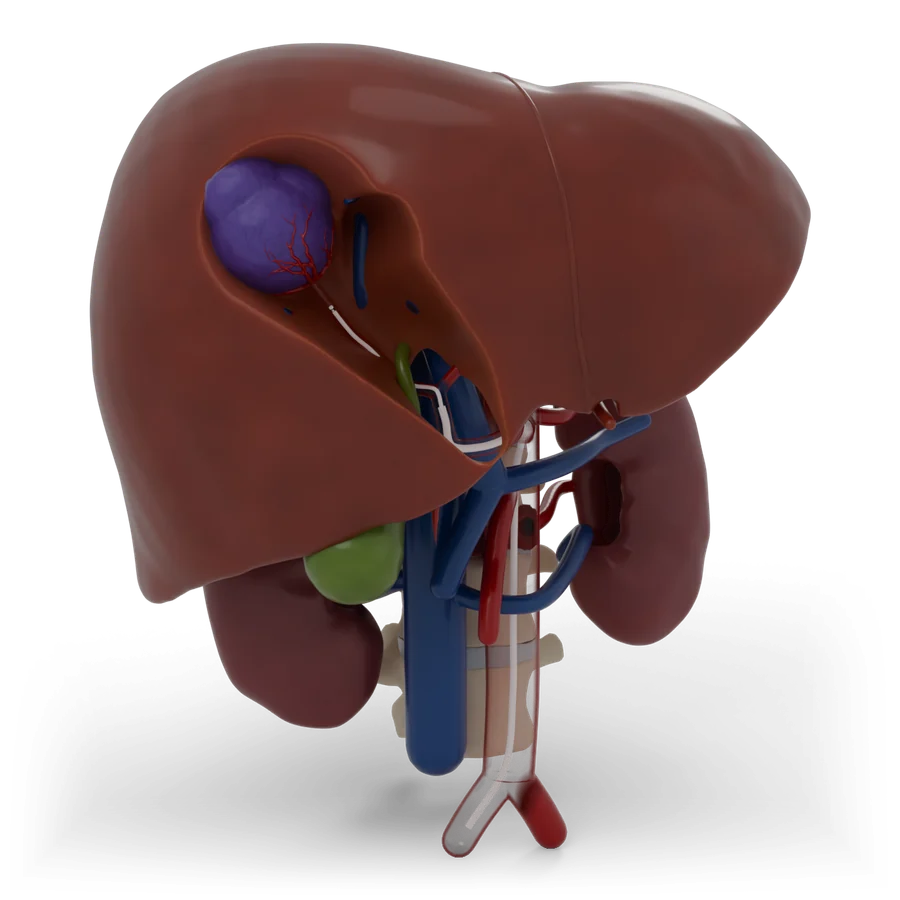
When a bile duct is blocked, bile backs up into the liver and turns your skin and eyes yellow. A biliary drain is a thin tube that goes through the skin of your right side and through the liver into the blocked duct. It is usually put in while you are relaxed and numbed, and it lets the bile drain again so the yellow colour and itching can settle. Your letter may call it PTBD.
- Usually awake
- with numbing and medicine to relax you
- About an hour
- in the IR department, for many people
- Same day or overnight
- depending on the hospital and how you are
- Every 2 to 3 months
- the drain is changed, if you need it long term
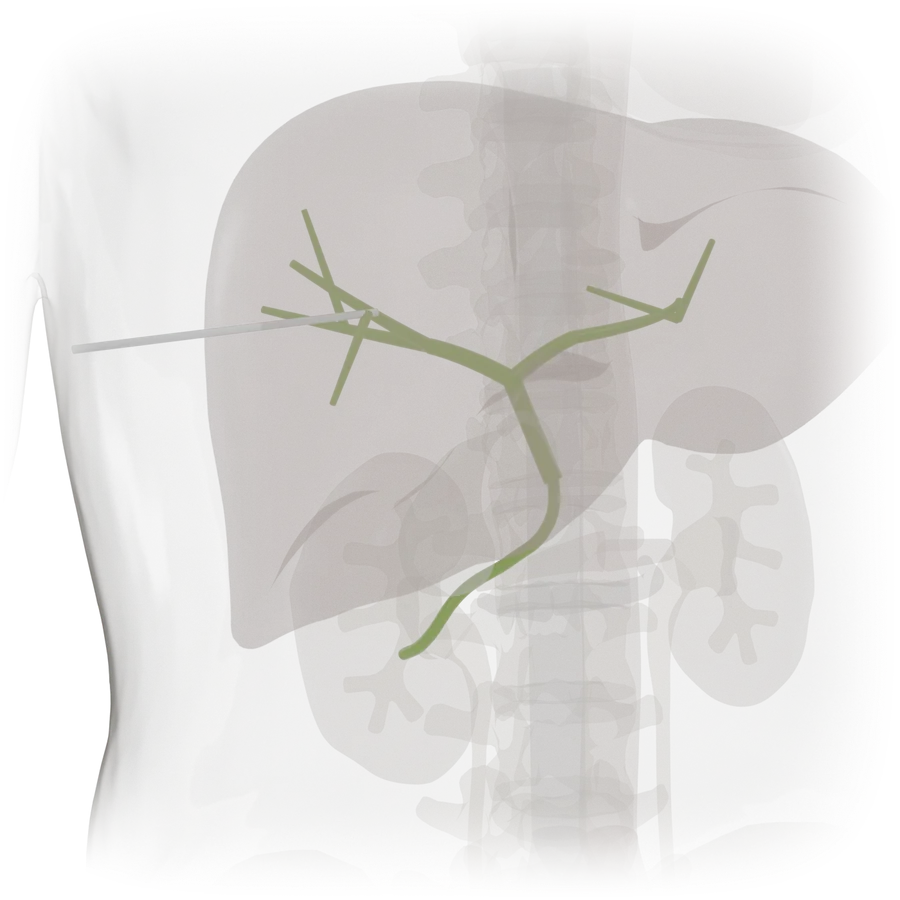
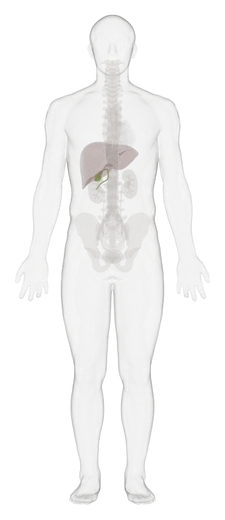
Where this happens: Upper right belly. The drain usually goes in on your right side, between the lower ribs or just below them. It passes through the liver into the bile ducts, and the outside end joins a bag.
The short version
A biliary drain is a thin, soft tube put through the skin of your right side and through the liver into a blocked bile duct, so bile can drain again.
It is done in the IR department with numbing medicine and medicine to relax you, and it often takes about an hour.
Bile drains into a bag outside your body, or past the blockage into your bowel, and the yellow colour and itching should slowly get better.
You will learn to care for the drain at home. If you need it for a long time, it is changed every 2 to 3 months, and some people later get a stent so the drain and bag can come out.
Step through it on the model
Start from the beginningEach step explains one thing. The 3D model for this guide is being made. Jump to any step.
See all 12 steps
What it treats
Living with your drain
Your visit
What to do before, what happens on the day, and what recovery is usually like. Your care team will give you instructions for your own situation. Follow theirs if they differ.
Before your procedure
Things to do. Tick them off as you go; your ticks stay on this device only.
On the day
You change into a gown. A nurse puts an IV in your arm or hand. The IR doctor explains the procedure and asks you to sign a consent form.
You lie on your back on an X-ray table. Monitors check your heart rate, blood pressure and oxygen.
Most people get medicine to relax and feel sleepy, and stay awake. Some are put fully to sleep.
Your right side is cleaned and numbed. Ultrasound and live X-ray guide a thin needle, a wire and then the drain into the bile ducts.
The drain is fixed to your skin and joined to a bag. Expect to be in the department for about an hour.
Some people go home the same day. Others stay one night or go back to their hospital ward.
Recovery
- The first hours
Bed rest for a few hours while nurses check you. Some pain and nausea are common and can be treated. The bile may look bloody for a day or two.
- The first day
Rest and have an adult with you. For 24 hours after sedation, do not drive, drink alcohol or sign important papers.
- Your first shower
After 24 to 48 hours, with the dressing covered by plastic wrap or a waterproof patch. No baths, swimming or hot tubs.
- Every day
Check the tube, skin and ink mark. Flush if you were told to. Empty the bag before it is half full and before bed, and write down how much drained. If more than 500 mL drains in a day, tell the IR team. They will tell you what to drink to replace lost fluid and salts.
- Every week
Change the dressing, or sooner if it is wet, loose or dirty. You may have liver blood tests every 1 to 2 weeks at first.
- Every 2 to 3 months
If you need the drain long term, it is changed in the IR department. Book ahead.
- Later
A capping trial, a stent, or treatment of the cause may mean the drain and bag can come out.
When to get help
Call 9-1-1 now if you have
- Chest pain.
- Trouble breathing.
- Slurred speech.
- Trouble with balance.
- Trouble using your arms or legs.
- Any time you think it is an emergency.
Call the interventional radiology (IR) team today if you have
- A fever of 38 °C or higher, or chills.
- Heavy bleeding.
- New blood in the bag.
- The drain stops draining, or much less drains than usual.
- The drain has come out or moved, or the ink mark is in a new place.
- Leaking around the tube.
- The tube leaks when you flush it.
- You cannot flush the tube, or flushing hurts.
- Pain, redness, swelling, warmth or pus where the tube goes in.
- New or worse yellow skin or eyes.
- Nausea or vomiting.
- New or worse belly pain.
- You cannot pass stool or gas.
- The tap is broken or open.
- The tubing has a kink you cannot straighten.
Phone number added by the hospital before launch
If you can’t reach them, go to the nearest emergency department.
Not sure? Call HealthLink BC at 8-1-1
- Questions that are not urgent.
- You cannot reach the IR team and are not sure how urgent something is.
A nurse can give health advice any time, day or night.
Call 8-1-1Deaf or hard of hearing: call 7-1-1. Translation services are available in over 130 languages.
Benefits and risks
What it can do for you
- Draining the bile takes pressure off the liver and lowers the risk of infection and liver failure.
- The yellow colour of your skin and eyes, and the itching, get better as bile drains.
- It can get you ready for surgery or other treatment of the bile ducts.
- Placing the drain usually works. One large centre succeeded in 566 of 599 people (about 95 in 100). It can be harder when the ducts are not swollen, but success in 90 to 100 in 100 people has been reported.
- Jaundice improved in 75 to 98 in 100 people, across studies.
- If a stent is placed later, bile drains inside your body in the normal way, with no outside drain. In cancer-related blockages, half of metal stents are still open after about 7 to 9 months.
What can go wrong
Every procedure has some risk, and most people do not have a serious problem. Each risk is listed with how often it happens. They are grouped on one scale, from very common to very rare.
Very common: more than 1 in 10 people
Pain
Up to 55 in 100 people.
Where this number comes from
Up to 55 in 100 people in studies.
Soreness where the tube goes in is expected. There can be pain between the ribs if the tube goes there, and a dull ache in the right shoulder. Pain medicine helps.
Bile leaking around the tube
Up to 33 in 100 people.
Bile can seep out where the tube comes through the skin, and the dressing gets wet. Change a wet dressing and tell the team.
Drain slips, comes out or blocks
The drain slipped or came out in about 11 in 100 people (63 of 599), in one large centre. How often it blocks is not known.
The drain can move or be pulled out if it catches on something. It may need to be put back or replaced. Over time, sludge can clog the tube, or the tubing can kink. Flushing and routine tube changes help prevent this.
Infection in the bile ducts or the blood
Bile duct infection happens to about 3 to 12 in 100 people, across studies. Infection in the blood happens to about 2 to 3 in 100, in an older expert guideline.
The bile in the ducts can get infected (cholangitis), causing fever and chills. It is treated with antibiotics. Sometimes germs get into the blood (sepsis) and make you very unwell for a while. Antibiotics before the procedure help prevent this.
Common: 1 in 10 to 1 in 100 people
Bleeding
Serious bleeding happens to about 2 to 3 in 100 people. An operation to stop bleeding was needed in 2 of 599 people, in one large centre.
Bleeding can happen through the skin, inside the belly, or into the bile ducts, which shows as blood in the bag. It is usually slight. If it goes on, you may need a blood transfusion. Once in a while, another IR procedure or an operation is needed to stop it.
Leak, infection or injury inside the belly
About 1 in 100 people, in an older expert guideline that counts these and pancreatitis together. A bowel injury happened to 1 of 599 people, in one large centre.
Bile can leak inside the belly, or a pocket of infection or swelling can form there or in the gallbladder. Once in a while, the needle or tube injures a nearby organ, such as the bowel.
Pancreatitis
About 1 in 100 people.
Where this number comes from
About 1 in 100 people (7 of 599), in one large centre. Studies range from about 1 in 200 to 6 in 100.
The pancreas can become inflamed (swollen and sore). This causes belly pain. It is treated the same way as pancreatitis from any other cause.
Risk to life
About 2 in 100 people.
Where this number comes from
About 2 in 100 people (1.7 in 100), in an older expert guideline. One recent large centre had 1 death in 599 people.
The procedure carries a risk of death. The risk of all problems depends on how ill people are before the procedure, and on the cause of the blockage. A recent large centre had fewer deaths than an older expert guideline.
Uncommon: 1 in 100 to 1 in 1,000 people
Chest problems
About 1 in 200 people.
Where this number comes from
About 1 in 200 people, in an older expert guideline.
Bile or air can get into the space around the right lung. Air there is called a pneumothorax. If you have chest pain or trouble breathing, call 9-1-1.
Other options
Other options (5)
Questions to ask
Tick the ones you want to ask. Your ticks stay on this device only.
Check your understanding
Check your understanding (5)
Nothing is saved. It is just for you.
When the duct is blocked, bile cannot reach the bowel, so it backs up and causes jaundice.
A biliary drain goes through the skin between or below the lower ribs, then through the liver into the bile ducts. A scope through the mouth is a different procedure, called ERCP.
An external drain stops above the blockage. An internal-external drain crosses it and ends in the bowel.
A drain that stops may be blocked or have moved. Call right away. If you also have chest pain or trouble breathing, call 9-1-1.
Keep the drain site dry. Do not take baths, swim or use a hot tub while the drain is in.
Words used
Words used (12)
- Bile
- A yellow-green juice made by the liver that helps digest fat.
- Bile duct
- A small tube that carries bile from the liver to the bowel.
- Bilirubin
- A yellow waste product carried in bile. Too much makes the skin and eyes yellow.
- Jaundice
- Yellow skin and yellow whites of the eyes.
- Duodenum
- The first part of the small bowel, just after the stomach.
- Stricture
- A narrowed part of a duct.
- Cholangitis
- An infection in the bile ducts.
- PTBD
- Percutaneous transhepatic biliary drainage. A drain put through the skin and the liver into the bile ducts.
- Internal-external drain
- A drain that crosses the blockage, so bile can flow into the bowel or out to a bag.
- Stent
- A small mesh or plastic tube left inside a duct to hold it open.
- Fluoroscopy
- Live X-ray video, used to guide the wire and drain.
- ERCP
- A procedure where a scope is passed through the mouth to treat the bile duct from the inside.
Sources
Sources (15)
- Cardiovascular and Interventional Radiological Society of Europe (CIRSE). Percutaneous transhepatic biliary stenting and drainage, patient information (2025)
- Cardiovascular and Interventional Radiological Society of Europe (CIRSE). Quality improvement guidelines for percutaneous transhepatic cholangiography and biliary drainage (Hatzidakis, Adam and Bezzi)
- British Society of Interventional Radiology and The Royal College of Radiologists. Percutaneous transhepatic cholangiogram (PTC) and drainage, patient information (2011)
- US cancer centre patient guide. About your biliary drainage catheter
- US university hospital patient guide. Percutaneous biliary drain (clinician review 2024)
- Cleveland Clinic. Biliary drainage: what to expect (2023)
- Cleveland Clinic. Bile duct obstruction (2024)
- HealthLink BC. Bilirubin test
- HealthLink BC. Endoscopic retrograde cholangiopancreatogram (ERCP)
- NHS. Jaundice (reviewed 2024)
- Indian Journal of Radiology and Imaging. Indian College of Radiology and Imaging evidence-based guidelines for percutaneous image-guided biliary procedures (Madhusudhan and others, 2021)
- PLoS ONE. Percutaneous transhepatic drainage is safe and effective in biliary obstruction: a single-center experience of 599 patients (Kokas and others, 2021)
- RadiologyInfo.org (RSNA and ACR). Biliary interventions (reviewed May 2024)
- Healthwise, via MyHealth.Alberta.ca (Government of Alberta). Learning about biliary drain care
- HealthLink BC. HealthLink BC 8-1-1 services
About this guide
About this guide
- Status
- Draft: not yet reviewed by the clinical team. The interventional radiology team will review it before it is used with patients, and the date of that review will show here.
- How it was written
- Drafted with AI writing tools from 14 published sources, then fact-checked against those sources by a separate AI check. Anything the sources did not support was taken out. The interventional radiology team will review it before it is used with patients.
- Last edited
- 14 October 2026
- Document
- Pathway P-008 · Version 0.5 · Last reviewed: not yet · Next review: 12 months after sign-off · Owner: the interventional radiology team
Was this guide clear?
Tell us if anything was hard to follow, or if something on the page looks wrong. Please do not include details about your own health. For questions about your care, contact your care team.
Both open an email to the project team. Project email: added before launch